

Introduction
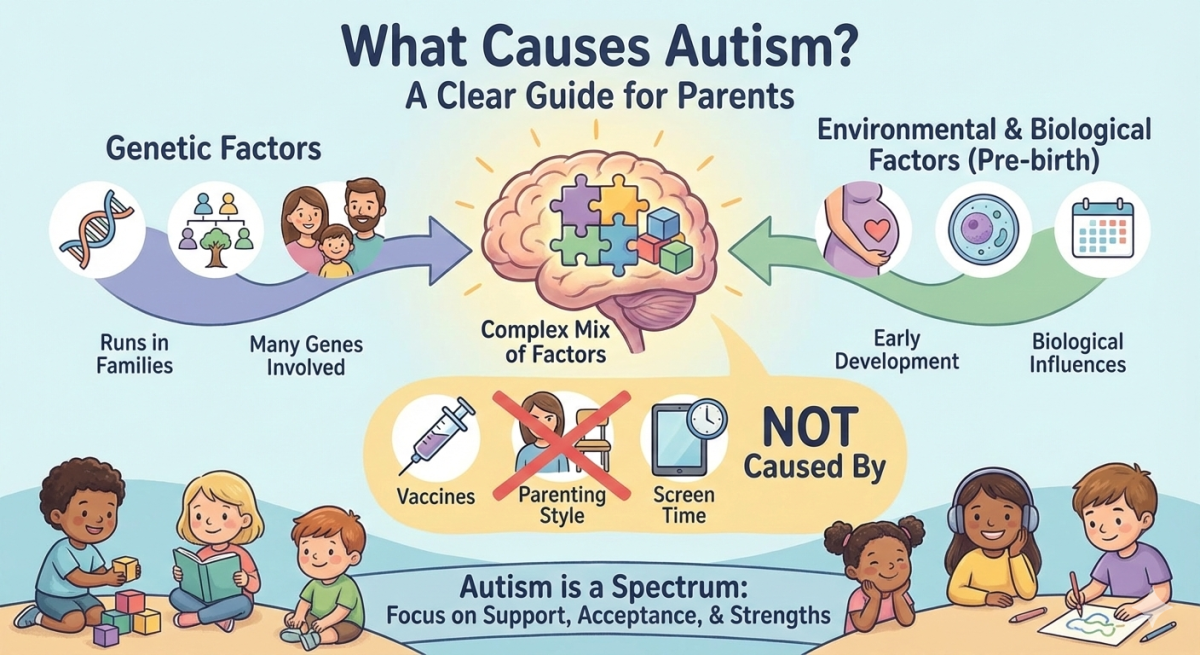
As a parent, caregiver or curious person, you might have wondered what causes autism, especially if you are related to one on the spectrum. It’s a very common question because people want to understand causation and possible treatment, as well as want answers they can trust. The absolute truth is that there is no single known cause of autism. Rather, autism results from a complex mix of factors, including genetics and environmental influences that affect brain development very early on, often before birth. Science is ever evolving as the body of research expands.
In this guide, we’ll walk you through what the research says in straightforward terms so you can understand:
- Why there is no one “cause” of autism
- What genetic factors are involved
- What environmental factors might play a role
- Why things like vaccines, parenting style, or screen time do not cause autism
What Is Autism?
Autism, also known as Autism Spectrum Disorder (ASD), is a lifelong neurodevelopmental condition. It affects how a person communicates, socially interacts, processes sensory information, and behaves.
Autism is called a spectrum because it affects people in different ways and to different degrees. Some children may speak early, while others may speak later or use alternative forms of communication. Some may need significant support, while others live independently.
Importantly, autism is not caused by bad parenting, emotional neglect, or something you did wrong.
There Is No Single Cause of Autism
According to the World Health Organization and the U.S. Centers for Disease Control and Prevention, autism does not have one clear cause that applies to every child . Instead, autism develops through a combination of factors, which may differ from one person to another.
Scientists describe autism as multifactorial, meaning:
- Several genetic factors
- Several environmental or biological factors
-
And the interaction between them
all play a role.
Genetic Factors: A Major Contributor
Genetics plays a significant role in autism. This means autism is strongly linked to how genes influence brain development.
How genetics are involved
Research shows that:
- Autism tends to run in families
- Having one child with autism increases the likelihood that a sibling may also be autistic
-
Certain genetic conditions are strongly associated with autism
Large studies of twins and families show that genes account for a substantial proportion of autism risk, although they do not explain everything.
Gene changes and variations
Scientists have identified:
- Inherited genetic variations
- New (spontaneous) genetic changes that occur during early development
- These genetic differences can affect how brain cells form, connect, and communicate.
What this means for you
Having genetic risk does not mean autism is inevitable. Genes create a susceptibility, not a certainty. Many children with genetic risk factors never develop autism, which tells us that other influences are also involved.
Environmental Factors: What Research Suggests
When researchers talk about environmental factors, they are not referring to parenting style or home environment. In autism research, environmental factors usually mean biological events or exposures before or around birth.
These factors do not cause autism on their own but may increase risk when combined with genetic vulnerability.
Advanced parental age
Studies have found that children born to older parents, especially older fathers, may have a slightly higher chance of autism . This may be linked to changes in genetic material over time.
Pregnancy-related factors
Certain maternal health conditions during pregnancy have been associated with increased autism risk, including:
- Diabetes
- Obesity
- Severe infections
- Immune system activation
Birth complications
Factors such as:
- Premature birth
- Low birth weight
- Lack of oxygen during delivery
have been observed more often in autistic children, although these are risk associations, not direct causes.
Environmental exposures
Some studies suggest that exposure to certain chemicals or medications during pregnancy may increase risk, but these situations are uncommon and often involve high levels of exposure.
What Does NOT Cause Autism
Clearing up myths is essential, because misinformation can cause fear, guilt, and stigma.
Vaccines do NOT cause autism
Extensive scientific research across millions of children has found no link between vaccines and autism. This conclusion is supported by the WHO, CDC, and paediatric organisations worldwide.
Parenting style does NOT cause autism
Autism is not caused by lack of affection, style of discipline for the children, or emotional bonding. These outdated beliefs have been completely rejected by modern science.
Screen time does NOT cause autism
While excessive screen use can affect attention or behaviour, it does not cause autism. Autism begins early in brain development, long before screens play a role.
Why Autism Looks Different in Every Child
No two autistic children are exactly the same because:
- Different genes may be involved
- Different biological factors may interact
- Developmental timing varies
This is why autism presents as a spectrum.
One child may have strong language skills but struggle socially, while another may be non-verbal but highly perceptive. These differences reflect individual brain wiring, not severity of parenting or effort.

Ongoing Research and Hope for the Future
Autism research is advancing rapidly. Scientists are now studying:
- Gene-environment interactions
- Brain development pathways
- Early biological markers
The goal is not to “cure” autism, but to:
- Improve early identification
- Personalise support
- Enhance quality of life
What This Means for You as a Parent
Here is what you can take away with confidence:
- Autism has no single known cause
- Genetics play a major role, but not alone
- Environmental and biological factors may influence risk
- Autism is not your fault
- Your focus should be on support, acceptance, and early intervention
Understanding the causes of autism is not about blame-it is about empowerment.
Conclusion
Autism develops from a complex mix of genetic and biological factors, most of which occur before birth. There is no single trigger, no simple explanation, and no parental mistake that causes autism. What matters most is early support, informed care, and creating an environment where your child can thrive.
FURTHER READING
Standard Developmental Milestones.
Mistakes parents make after an autism diagnosis.
Evidence-based questions parents often ask about autism.
REFERENCES
1. Centers for Disease Control and Prevention (CDC). Autism spectrum disorder (ASD): Causes and risk factors. Atlanta (GA): CDC; 2024.
Available from:
https://www.cdc.gov/autism/about/causes.html
2. World Health Organization (WHO). Autism spectrum disorders: Key facts. Geneva: WHO; 2023.
Available from:
https://www.who.int/news-room/fact-sheets/detail/autism-spectrum-disorders
3. Hallmayer J, Cleveland S, Torres A, et al. Genetic heritability and shared environmental factors among twin pairs with autism. Arch Gen Psychiatry. 2011;68(11):1095–1102.
Available from:
https://pubmed.ncbi.nlm.nih.gov/21727249/
4. Sandin S, Lichtenstein P, Kuja-Halkola R, et al. The familial risk of autism. JAMA. 2014;311(17):1770–1777.
Available from:
https://pubmed.ncbi.nlm.nih.gov/24794370/
5. Hertz-Picciotto I, Delwiche L. The role of parental age in autism. Epidemiology. 2009;20(1):84–90.
Available from:
https://pubmed.ncbi.nlm.nih.gov/19234402/
6. Modabbernia A, Velthorst E, Reichenberg A. Environmental risk factors for autism. Mol Autism. 2017;8:13.
Available from:
https://pubmed.ncbi.nlm.nih.gov/28239434/
7. Rossignol DA, Genuis SJ, Frye RE. Environmental toxicants and autism spectrum disorders. Transl Psychiatry. 2014;4:e360.
Available from:
https://pubmed.ncbi.nlm.nih.gov/24651333/
8. Gardener H, Spiegelman D, Buka SL. Prenatal risk factors for autism: Meta-analysis. Br J Psychiatry. 2009;195(1):7–14.
Available from:
https://pubmed.ncbi.nlm.nih.gov/19567888/
9. Satterstrom FK, Kosmicki JA, Wang J, et al. Large-scale exome sequencing study in autism. Cell. 2020;180(3):568–584.e23.
Available from:
https://pubmed.ncbi.nlm.nih.gov/31981491/
10. Hyman SL, Levy SE, Myers SM. Identification and management of autism spectrum disorder. Pediatrics. 2020;145(1):e20193447.
Available from:
https://pubmed.ncbi.nlm.nih.gov/31843864/


Dr. Chisom Pascaline, MBBS, IBCCES Certified Autism Specialist (CAS), is a medical doctor, autism specialist, and founder of Autism Parenting in Nigeria - A widely accessed autism education platform serving thousands of families monthly, trusted across Africa.
She has been a guest contributor to BellaNaija, Lagos Mums, Exceptional Needs, and Health Guide Nigeria, and has been recognized and featured by The Sun Nigeria for her...